
This history is provided by Muse’s original creators and documents the development and restoration of the game.
Who created Muse?
Muse was created by Jeffrey Baker and Perry Glover in Richmond, Virginia, in 1994. At the time, Jeff and Perry were programmers working together at Performance Food Group, and Muse was written alongside that work rather than as part of it.
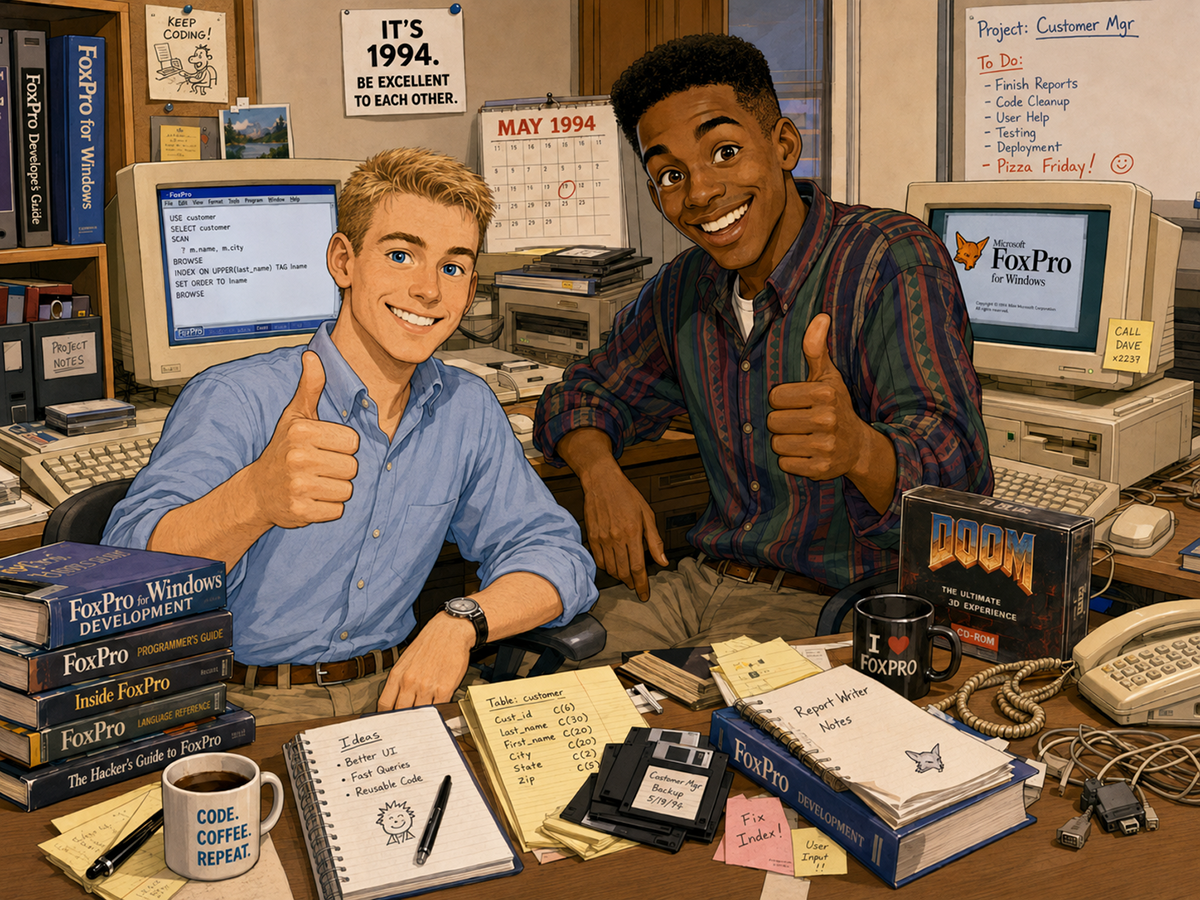
When was Muse created, and what was it written for?
Muse was written in 1994 for Windows 3.11, and that is where it stayed. It was never converted to run on later versions of Windows, so when 16-bit applications stopped running on ordinary PCs the game stopped with them. More than thirty years passed before it ran again.
Was Muse based on Sokoban?
Muse was inspired by Sokoban, the Japanese box-pushing puzzle created by Hiroyuki Imabayashi (今林宏行) in 1981. Sokoban began as a hobby project written in BASIC for an NEC PC-8001 and was released commercially in Japan shortly afterward.
Over the following years, versions of Sokoban and games like it spread onto VAX/VMS, Unix, DEC and the other systems in use at universities and large companies. It was one of those deceptively simple games: easy to understand, and extremely difficult to master.
Muse took that central rule — a block can be pushed but never pulled — and built its own game around it, with its own pieces, its own scoring and, in the end, its own library of puzzles.
Who wrote the Muse levels?
Many of them were written by players. Muse collected puzzles from the people who played it, and that collection is what made the game worth saving: the code could have been written again, but a level somebody designed in 1996 could not.
That is the reason the game came back at all. The levels had survived on scans and printouts, and letting them go with the technology they were built for was the one outcome nobody wanted.
What happened to Muse after 1994?
Nothing, for thirty years. The game sat on old media and older hardware, unplayable on any current computer, while the levels sat in boxes as paper.
In 2026 it was rebuilt for the browser by 3ring, LLC, and the original levels were recovered from those scans with the help of AI — a process with a page of its own, because it is the interesting part.