This account is written by the team that carried out the restoration, 3ring, LLC, working from the original creators’ own material.
The problem: a game that outlived the computers it ran on
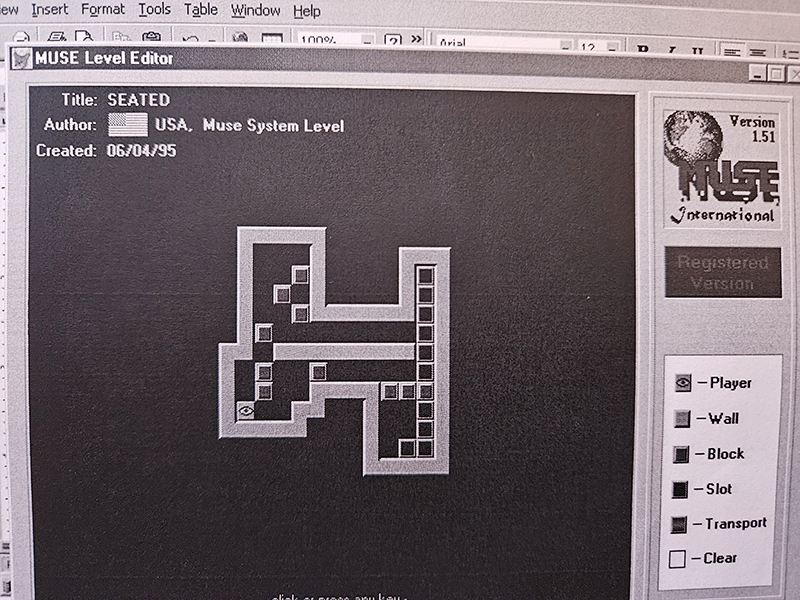
Muse was written in 1994 for Windows 3.11 and never converted. What survived was not the software but the puzzles — many of them designed by players — and they survived as paper: scans and printouts made before the machines went away. The job was to turn a stack of pictures back into a game.
Step 1 — Teach the model the rules
The AI was given the rules of Muse before it was given a single picture: how the player moves, how blocks move, how slots and transports work, which moves are legal, and what simply cannot occur on a board.
This is the part that does the work. Without the rules, a scan is a picture and every mark on it is equally plausible. With them, the scan is a board, and a board has to make sense — blocks and slots balance, the floor is enclosed, the player stands somewhere they could stand. A reading that breaks a rule is wrong before anyone looks at it.
Step 2 — Describe the geometry
It was also given the structure of a board: the uniform size and spacing of the game’s pieces, and the coordinate system used to position objects on a level. That is what turns a mark somewhere on a page into row 7, column 4.
Step 3 — Read the scan
Given the rules and the geometry, the AI analysed a scanned image of an original level and worked out where the objects in it were: walls, blocks, slots, transports, and the player’s starting position.
Step 4 — Write the level data
Those positions were translated back into the format the rebuilt game reads — one text row per line of the board, one character per square. At that point a puzzle that existed only as a photograph is a file the game can load.
Step 5 — Verify it by machine
Every recovered level is then checked by a solver: that it is enclosed, that its blocks and slots balance, and above all that it can be solved.
This step is not optional and it is the one that makes the rest trustworthy. A misread wall does not look like an error — it looks like a slightly different puzzle, and it can quietly make a level impossible. No amount of confidence from a model substitutes for a program finding the solution, so nothing ships until one has.
What this replaced
The alternative was to rebuild every level by hand, square by square, from a photograph. It was possible. It was also slow enough that the collection would probably never have been finished, and error-prone in exactly the way that is hardest to catch.
What once would have required manually recreating every square of every level could be dramatically accelerated instead — and, because the output is verified by a solver rather than by eye, the recovered levels are checked more thoroughly than hand-typed ones would have been.
What is CLAUDEus Caesar?
CLAUDEus Caesar is the AI level designer used by Muse to create new Muse puzzle levels based on patterns and rules learned from the game’s original puzzles.
Reading the old levels taught the model a great deal about how a Muse puzzle is put together. The next step was to have it design them: not variations on the originals, but new boards built from what those boards taught it.
CLAUDEus Caesar’s levels appear in the game alongside the originals. They carry his name where the other levels carry their author’s, and a sparkle where those carry a flag, so a player always knows which is which. Every one of them is checked by machine before it ships: solvable, and solvable the hard way.
Does this generalise beyond a puzzle game?
The shape of it does. Wherever what survives of a system is a picture of structured data — a form, a board, a schematic, a printed table — and the structure obeys rules, the same three moves apply: give the model the rules and the geometry, have it read the image into coordinates, and then verify the result with a program instead of trusting the reading.
The limit is equally plain: nothing can be recovered that the paper never recorded. The scans held the boards, so the boards came back. They held nothing about the code, so the code was written again.